Support & Email
Customer Support
Our Location
7765 Pecue Lane, Baton Rouge, LA 70809
7765 Pecue Lane, Baton Rouge, LA 70809
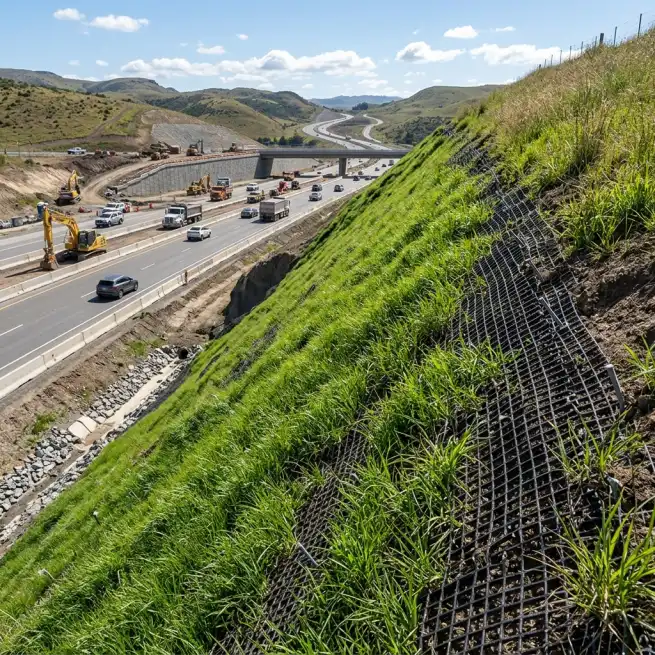
Soil erosion costs the United States an estimated $37 billion annually in lost productivity, infrastructure damage, and environmental remediation. For construction professionals, erosion and sediment control (ESC) is not merely a regulatory checkbox � it is a fundamental aspect of responsible site management that protects waterways, preserves topsoil, prevents costly fines, and maintains community goodwill. At Industrial Fabrics Inc., we have spent decades developing erosion control solutions for some of the most challenging environments in North America, and we want to share the best practices that deliver results on real projects.
Erosion on construction sites occurs through four primary mechanisms, each requiring different control strategies:
Industrial Fabrics Inc. offers a comprehensive suite of erosion control products engineered to address all four erosion mechanisms across the full spectrum of site conditions.
Our photodegradable and biodegradable erosion control blankets provide immediate surface cover and rainfall interception on disturbed slopes during the critical vegetation establishment period. The blanket matrix absorbs raindrop energy before it can dislodge soil particles, while the woven structure promotes uniform seed germination by maintaining consistent soil moisture and temperature.
IFI ECBs are available in single-net and double-net configurations, with straw, wood fiber, coconut coir, and blended fill materials selected to match expected service life and vegetation establishment timeline:
Our SiltGuard� woven silt fence fabric exceeds AASHTO M288 Class C specifications for sediment filtration efficiency and survivability. Unlike commodity silt fence materials, SiltGuard� is manufactured with consistent thread count and aperture size to deliver predictable flow-through rates that prevent ponding while capturing particles sized 20 microns and larger.
Where standard silt fence is insufficient � high-flow channels, slopes with concentrated flow, or perimeter situations requiring sediment basin function � our EnviroTubes� geocontainer system provides superior performance. Filled with native soil, sand, or compost, EnviroTubes� are permeable structures that allow clean water to pass while capturing suspended sediment. Their weight and flexibility allow them to conform to irregular terrain and remain effective even where grade changes make traditional silt fence ineffective.
Regulatory agencies require a Storm Water Pollution Prevention Plan (SWPPP) for most construction sites disturbing one acre or more. But a SWPPP that satisfies regulatory review on paper is very different from a SWPPP that actually prevents ESC failures in the field. The distinction comes down to implementation specifics.
Product selection must be matched to site-specific hydraulic conditions. The most important variables are slope gradient (run/rise ratio), slope length, and design rainfall intensity for the region. These three factors determine peak runoff velocity, which governs both the shear stress that erosion control products must resist and the sediment transport capacity that perimeter controls must manage.
As a general guideline for the contiguous United States:
Every engineered erosion control product is temporary. The only truly permanent erosion control is a dense stand of well-established vegetation with intact root systems. This means that seeding selection, application timing, seed bed preparation, and post-establishment maintenance are ultimately as important as the choice of erosion control blanket or silt fence type.
Industrial Fabrics Inc. partners with regional seed suppliers to provide site-specific seed mix recommendations that account for local climate, native species availability, regulatory preferences for native versus non-native mixes, and establishment timeline relative to construction schedule.
For project-specific ESC planning support, product specification assistance, or SWPPP review consultation, contact our engineering team at info@ind-fab.com or call +1 (800) 848-4500.